
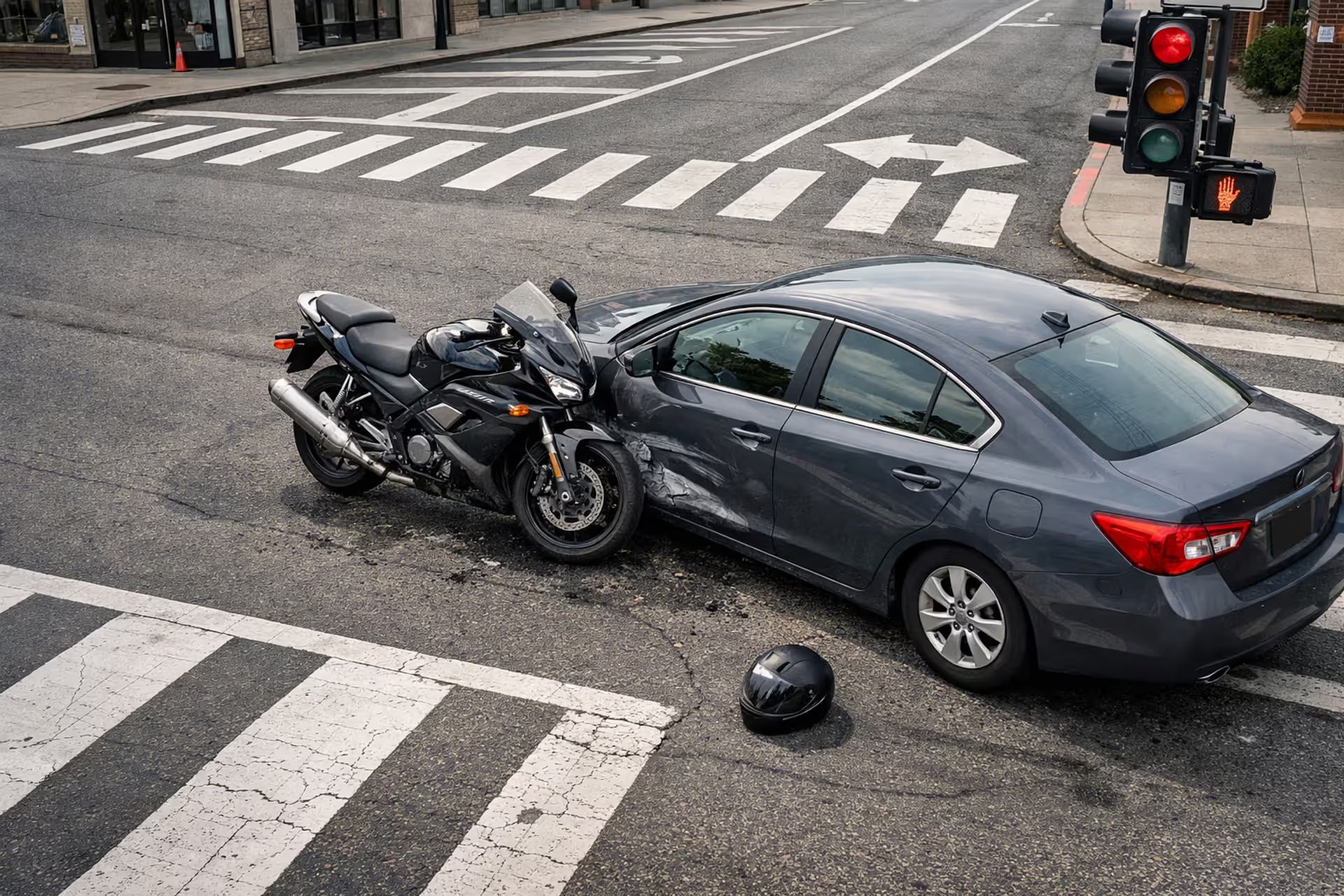
Overhead view of a city intersection with a motorcycle and car after a minor collision, helmet on the ground, traffic lights and buildings in the background
How Motorcycle Accident Insurance Premium Factors Impact Your Rates

Understanding why your motorcycle insurance premium jumps after an accident requires looking behind the actuarial curtain. Insurers don't simply slap on arbitrary surcharges—they recalculate your risk profile using dozens of weighted variables. A 32-year-old rider with a spotless record who rear-ends a car at a stoplight might see a 40% rate hike, while a 19-year-old on a sport bike with the same fender-bender could face a 75% increase. The difference lies in how companies layer accident data onto existing risk markers.
Premium calculations blend hard math with predictive modeling. Every claim you file feeds into algorithms that compare your profile against millions of other riders. Insurers track not just whether you crashed, but how you crashed, what you hit, how much they paid, and whether similar riders with similar accidents filed more claims later. This granular analysis explains why two neighbors riding identical bikes can pay vastly different premiums after comparable accidents.
What Insurance Companies Evaluate After a Motorcycle Accident
The moment you file a claim, underwriters pull your complete loss history from industry databases like LexisNexis and ISO ClaimSearch. These repositories aggregate claims across all carriers, meaning switching insurers won't hide your accident record. Underwriters examine the police report, damage estimates, medical bills, and witness statements to assign fault percentages and classify claim severity.
At-fault determinations carry the heaviest weight. If you're deemed 100% responsible for causing the accident, expect the maximum surcharge your state allows—often 20-40% for a first offense. Partial fault scenarios (say, 60% your responsibility in a lane-change collision) trigger proportional increases. Some carriers apply surcharges even at 51% fault, while others set thresholds at 75%.

Author: Hannah Pierce;
Source: spy-delhi.com
No-fault accidents present a gray area. Comprehensive claims for theft, vandalism, or weather damage typically don't trigger surcharges because they don't reflect riding behavior. Collision claims where you're not at fault should leave your rates untouched, but many insurers still apply minor increases—5-15%—citing statistical correlations between any claim activity and future risk. Massachusetts and California restrict this practice through regulation, but most states permit it.
Claims history creates a compounding effect. Your first at-fault accident might raise premiums 35%. A second within three years could double your base rate. A third often makes you uninsurable in the standard market, forcing you into high-risk pools with premiums exceeding $4,000 annually for basic coverage. Insurers view claim frequency as a stronger predictor than severity—three minor fender-benders signal worse risk than one moderate crash.
Rider-Specific Variables That Increase or Decrease Your Premium
Age intersects with accident history in non-linear ways. A 45-year-old with 20 years of riding experience who files a first claim sees modest increases because their long clean record buffers the impact. A 22-year-old with three years on two wheels faces steeper penalties because they lack that protective cushion of safe riding years. Actuarial tables show accident rates peak between ages 18-24, then decline steadily until age 60, when they tick upward again due to slower reaction times.

Author: Hannah Pierce;
Source: spy-delhi.com
Licensing credentials matter more after an accident. Holding just a learner's permit when you crash can triple the surcharge compared to having a full motorcycle endorsement. Advanced certifications from the Motorcycle Safety Foundation (MSF) or equivalent programs sometimes qualify for accident forgiveness on first offenses, though this varies by carrier. Progressive and GEICO both offer 5-10% discounts for MSF graduates that partially offset post-accident increases.
How Your Driving Record Multiplies Insurance Costs
Your automobile driving record feeds into motorcycle premium calculations. A speeding ticket on your car insurance raises your bike rates because insurers view all motor vehicle violations as risk indicators. DUI convictions create catastrophic premium spikes—often 150-300%—that persist for five to seven years regardless of whether the offense occurred in a car or on a motorcycle.
Multiple violations stack exponentially rather than additively. One speeding ticket plus one at-fault accident might raise your premium 50%. Add a second ticket and you're looking at a 90% increase. The third violation often triggers non-renewal. Insurers use point systems that assign weighted values: minor speeding (1-2 points), reckless driving (4-6 points), DUI (6-8 points). Once you accumulate 8-10 points, standard carriers decline coverage.
The Experience Penalty: New Riders vs. Veterans
Riders with fewer than three years of experience pay 60-80% more than veterans with identical bikes and demographics. Post-accident, that gap widens. A new rider's first at-fault claim signals to insurers that the learning curve isn't progressing normally. Statistical models show riders who crash in their first two years are 3.2 times more likely to file another claim within five years compared to those who make it past year three without incident.
Experienced riders earn benefit-of-the-doubt treatment. Someone with 15 claim-free years who has a single accident might qualify for accident forgiveness programs that waive the surcharge entirely. These programs typically require five consecutive clean years and enrollment before any claim occurs. Liberty Mutual and Nationwide offer this feature, though it adds $50-150 to annual premiums upfront.
Motorcycle Characteristics That Change Risk Calculations
Engine displacement directly correlates with insurance costs and post-accident surcharges. Sport bikes over 1000cc occupy the highest risk tier. A rider who crashes a Yamaha YZF-R1 faces steeper increases than someone who drops a Honda Rebel 500, even if the accident circumstances are identical. Insurers track claim frequency by make and model—supersport bikes generate claims at 4-5 times the rate of standard cruisers.
Bike type determines your baseline rate and how much accidents inflate it. Sport bikes start with premiums 200-300% higher than cruisers. After an accident, both categories might see a 40% increase, but 40% of $3,000 (sport bike) hurts more than 40% of $800 (cruiser). Touring bikes occupy middle ground—their higher value means costlier repairs, but their rider demographic (older, more cautious) moderates risk.
| Motorcycle Type | Typical Annual Premium (Clean Record) | Post-Accident Premium Range | Risk Multiplier |
| Sport Bike | $2,800–$4,500 | $3,900–$7,800 | 1.4–1.7× |
| Cruiser | $700–$1,200 | $980–$1,900 | 1.4–1.6× |
| Touring | $1,100–$1,800 | $1,540–$2,900 | 1.4–1.6× |
| Standard | $800–$1,400 | $1,120–$2,200 | 1.4–1.6× |
| Off-Road | $500–$900 | $700–$1,450 | 1.4–1.6× |
Rates based on 35-year-old rider with full coverage in mid-sized US city. Actual costs vary by state and carrier.
Safety features and anti-theft devices provide marginal relief after accidents. ABS-equipped bikes qualify for 5-10% discounts that persist post-claim. Comprehensive security systems (GPS tracking, alarms, immobilizers) reduce theft-related comprehensive claims but don't affect collision surcharges. Some insurers offer small credits for bikes with traction control or linked braking systems.
Modifications complicate claims and premiums. Aftermarket exhaust systems, performance tuning, or suspension upgrades must be disclosed. If you crash and the adjuster discovers undisclosed modifications, the carrier can deny the claim entirely or reduce payout. Post-accident, modified bikes face 15-25% higher premiums than stock equivalents because insurers assume modified bikes get ridden more aggressively.
Geographic and Usage Patterns in Premium Pricing
State regulations create dramatic premium variations. Michigan's unlimited medical coverage mandate makes it the most expensive state for motorcycle insurance—average premiums exceed $2,000 annually. Louisiana, with high uninsured motorist rates and permissive liability laws, ranks second. Meanwhile, Iowa and North Dakota see average premiums below $400 because of lower population density and fewer claims.
Urban riders pay 40-60% more than rural counterparts. Los Angeles and New York City lead in theft rates and accident frequency, driving up premiums across all coverage types. After an accident in a major metro area, expect surcharges at the high end of the range because you're competing with more traffic and higher claim costs. Rural riders benefit from fewer collision opportunities, though single-vehicle accidents (hitting deer, running off rural roads) partially offset this advantage.
Annual mileage declarations affect both base rates and post-accident increases. Riders logging under 3,000 miles yearly pay 20-30% less than those riding 15,000+ miles. If you crash while significantly exceeding your stated mileage, insurers may adjust your rate retroactively and apply surcharges to the higher mileage tier. Commuters face steeper penalties than recreational riders because daily exposure multiplies risk.
Storage conditions influence comprehensive and theft coverage but indirectly affect collision premiums. Garaged bikes in climate-controlled spaces signal owner responsibility, earning small discounts. Street parking in high-crime neighborhoods raises comprehensive premiums 30-50%. After an accident, insurers scrutinize whether poor storage contributed—a bike stolen from an unlocked garage might trigger a surcharge despite being a comprehensive claim.
How Accident Severity and Claim Amount Reshape Your Rates
Minor claims under $2,000 trigger smaller surcharges than major losses. A dropped bike in a parking lot with $800 in fairings damage might raise your premium 15-20%. A highway collision requiring $12,000 in repairs, medical bills, and third-party property damage could double your rate. Insurers use claim-to-premium ratios—if your claim exceeds three times your annual premium, expect maximum surcharges.
Bodily injury claims carry heavier penalties than property damage alone. An accident causing $15,000 in vehicle damage generates a smaller surcharge than one causing $15,000 in medical expenses. Injury claims open the door to long-tail liabilities—medical complications, lost wages, pain and suffering settlements—that can balloon costs years later. Insurers apply surcharges reflecting worst-case scenarios, not just initial payouts.
Total loss scenarios reset your risk profile. If your bike is totaled and you replace it with a similar model, the surcharge applies to the new bike's higher baseline rate. Switching to a lower-risk motorcycle after a total loss can partially offset the accident surcharge—trading a totaled Kawasaki Ninja for a Honda Shadow might keep your absolute premium increase under $500 despite a 40% surcharge on the new policy.
Most riders don't realize accident surcharges follow a decay curve rather than a cliff. You'll see the maximum increase for 12-18 months, then it typically drops by 10-15% annually if you remain claim-free. By year four or five, the accident's impact shrinks to 5-10% above your clean record rate. The key is avoiding any additional claims during that window—each new incident resets the clock
— Sarah Mitchell
Surcharge duration varies by state law and carrier policy. California limits accident surcharges to three years. Most states allow five years. Some insurers apply seven-year lookback periods for serious violations. The surcharge doesn't disappear overnight at the end of the period—it phases out as the accident ages beyond the primary rating window.
Strategies to Lower Premiums Despite Accident History
Defensive riding courses offer immediate discounts that partially offset accident surcharges. Completing an advanced MSF course or state-approved equivalent typically earns 10-15% reductions valid for three years. Some carriers waive first-accident surcharges entirely if you complete the course within 90 days of the claim. This strategy works best for riders whose accidents stemmed from skill gaps rather than recklessness.
Bundling policies leverages your total customer value. Combining motorcycle, auto, and homeowners insurance with one carrier can reduce your motorcycle premium 20-25%. After an accident, this bundling discount applies to the surcharged rate, providing meaningful savings. Shop bundles carefully—sometimes maintaining separate policies with different carriers costs less than bundling everything with your motorcycle insurer.
Raising deductibles from $500 to $1,000 or $2,000 cuts premiums 15-30%. Post-accident, this strategy makes sense if you have emergency savings to cover the higher out-of-pocket cost. A $1,000 deductible on a $2,400 annual premium saves roughly $360 yearly. If you remain claim-free for three years, you've saved $1,080—more than enough to cover the higher deductible if you crash again.
Accident forgiveness programs must be purchased before any claim occurs. These riders pay $75-200 annually for the guarantee that their first at-fault accident won't trigger a surcharge. After using accident forgiveness, premiums increase to reflect your new risk profile, but you avoid the immediate spike. This works best for experienced riders with clean records who want protection against one mistake.
Shopping competitors becomes essential post-accident. Your current carrier may surcharge you 50% while a competitor views your profile more favorably and increases rates only 25%. Obtain quotes from at least five carriers within 30 days of your renewal. Companies like Dairyland and Progressive specialize in higher-risk riders and often beat standard carriers' post-accident rates. Regional insurers sometimes offer better deals than national brands.
Usage-based insurance programs track your riding through smartphone apps or plug-in devices. Safe riding habits—smooth acceleration, gentle braking, avoiding night riding—earn discounts up to 30%. After an accident, enrolling in these programs demonstrates your commitment to improvement and can accelerate the rate reduction timeline. Some carriers reduce accident surcharges by 10% for participants who maintain top safety scores.
Author: Hannah Pierce;
Source: spy-delhi.com
FAQ: Understanding Motorcycle Insurance Premium Calculations After Accidents
Understanding motorcycle accident insurance premium factors empowers you to make informed decisions after a crash. Insurers don't apply arbitrary penalties—they recalculate your risk using weighted algorithms that consider your accident's specifics alongside dozens of other variables. The 40% surcharge that feels punitive actually reflects statistical modeling showing riders with recent at-fault claims file future claims at significantly higher rates than clean-record peers.
Smart riders minimize premium damage by acting strategically. Complete advanced training courses within weeks of an accident to qualify for immediate discounts. Shop at least five competitors before your renewal to find carriers that rate your profile more favorably. Consider raising deductibles or adjusting coverage levels to reduce premiums while maintaining adequate protection. Most importantly, remain claim-free during the 3-5 year surcharge window—each additional claim resets the timeline and compounds your costs.
The premium impact of an accident eventually fades if you demonstrate sustained safe riding. Insurers reward riders who learn from mistakes with gradually decreasing surcharges and eligibility for standard rates. Your goal isn't just surviving the immediate rate increase but positioning yourself to return to preferred-risk status as quickly as possible. That requires patience, strategic policy management, and—above all—keeping the rubber side down for the next several years.
Related Stories

Read more

Read more



The content on this website is provided for general informational and educational purposes only. It is intended to offer insights and guidance on motorcycle accident insurance claims, settlement processes, liability issues, coverage limits, medical compensation, and related insurance matters, and should not be considered legal or financial advice.
All information, articles, and materials presented on this website are for general informational purposes only. Insurance policies, liability standards, settlement practices, and state regulations may vary by jurisdiction and insurer. The outcome of a motorcycle accident claim depends on the specific facts of the accident, available evidence, policy language, and applicable law.
This website is not responsible for any errors or omissions in the content, or for actions taken based on the information provided. Users are strongly encouraged to consult with a qualified attorney or licensed insurance professional regarding their specific motorcycle accident claim before making decisions about settlements, negotiations, or coverage disputes.