

Motorcyclist sitting on roadside next to damaged motorcycle with helmet off, head in hands, emotional distress after crash at dusk
How to Recover From Motorcycle Accident Psychological Trauma

Most riders spend hours researching helmets, gear, and bike maintenance. Nobody prepares for the psychological aftermath of a crash—yet it often becomes the hardest part of recovery. You can see a broken bone healing on X-rays. You can't see the intrusive memory that hijacks your brain at 2 AM, making you relive the moment impact happens. Again. And again.
Motorcycle accident psychological trauma doesn't make you weak. It makes you human. And more importantly? It responds to treatment when you know what to look for and where to get help.
What Happens to Your Mind After a Motorcycle Crash
The Brain's Response to High-Impact Trauma
Here's what happened inside your skull during those seconds of impact: your brain dumped massive quantities of stress hormones into your system. We're talking cortisol, adrenaline, and norepinephrine at levels you'd never experience during regular life—not during a job interview, not during a breakup, not even during other types of accidents.
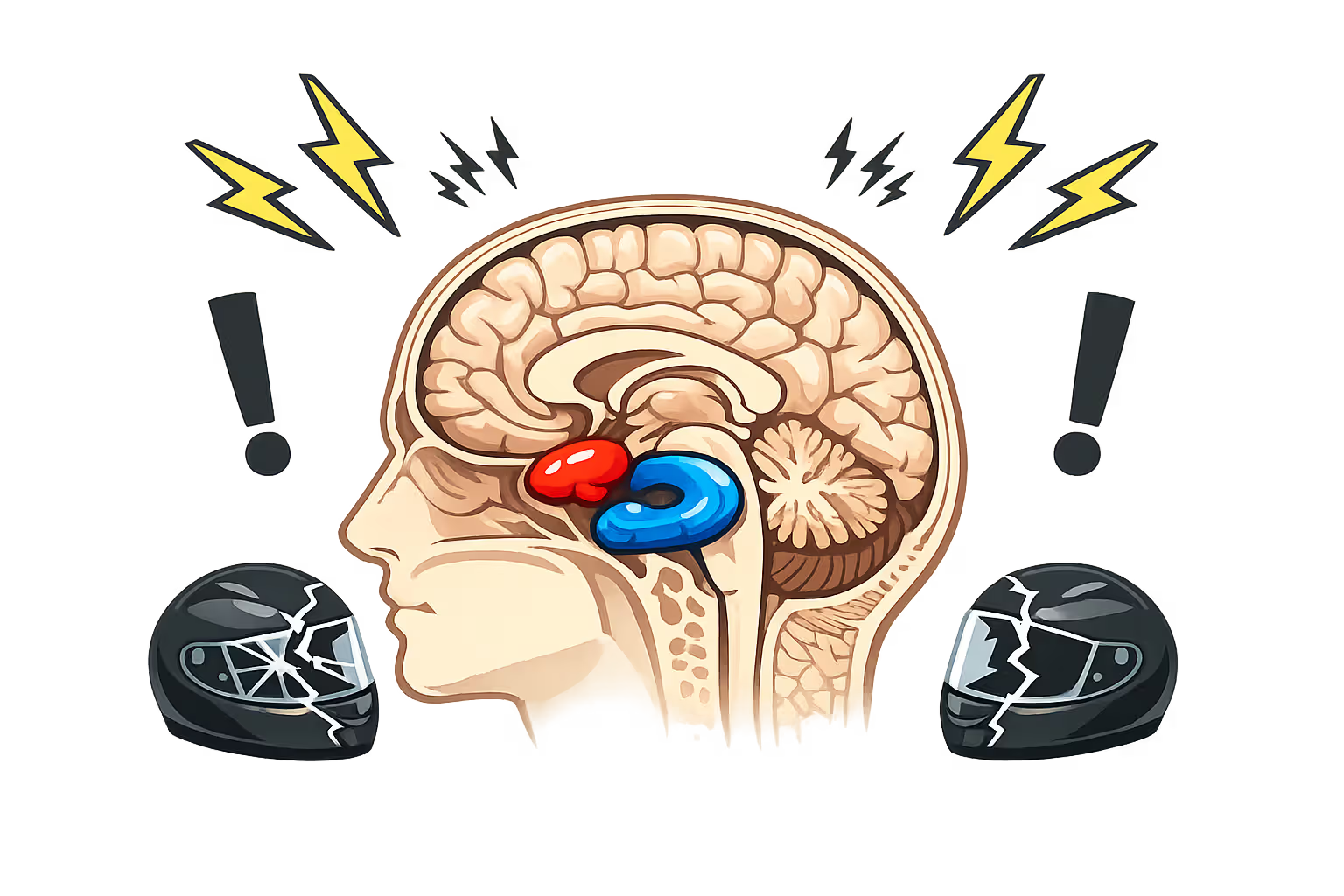
This chemical flood does something specific. Your amygdala—think of it as your brain's alarm system—essentially hits "record" with the intensity cranked to maximum. It stamps this event as critically important survival information. That's why you might remember bizarre details with absolute clarity: the smell of hot rubber, the specific pattern of cracks in the asphalt, the color of a bystander's jacket.
Meanwhile, your hippocampus (which normally organizes memories into neat chronological order) gets partially shut down by all those stress hormones. So you end up with this fragmented, emotionally supercharged recording instead of a normal memory. The accident exists in your mind as vivid sensory fragments rather than a coherent story with a beginning, middle, and end.
For plenty of riders, this neurological overreaction settles down naturally. Give it three weeks, maybe four, and your brain files the accident away properly. But for others? That amygdala stays stuck in high alert, treating every unexpected sound or sudden movement as a potential threat.
Why Motorcycle Accidents Trigger Intense Psychological Reactions
Motorcycles offer zero buffer between you and physics. When car drivers crash, they're surrounded by metal, airbags, and crumple zones. You've got your gear and then... direct contact with whatever you hit. Or whatever hits you.
This physical exposure translates into higher psychological injury rates compared to car accidents. Makes sense when you think about it—your body absorbed the impact directly. That visceral experience gets encoded differently than watching a crash through a windshield.
There's also the identity piece. A lot of riders don't just own motorcycles—they ARE motorcyclists. It's woven into their social life, their self-image, their Instagram bio. When a crash threatens that core identity, you're not just processing fear. You're grieving who you thought you were. That confident person who felt free on two wheels? Suddenly they feel fragile.
Then there's the vulnerability factor that every rider understands intellectually but doesn't really feel until after a crash. You always knew motorcycles were dangerous. Now you KNOW it in your bones, in your nightmares, in the way your chest tightens when you hear a bike engine. Some riders call it "losing the invincibility illusion." Others describe it as reality forcing itself into awareness in a way that can't be un-learned.
Author: Olivia Bennett;
Source: spy-delhi.com
Recognizing the Signs: From Acute Stress to PTSD
Early Warning Symptoms (First 30 Days)
Right after your accident, your nervous system is going to be a mess. That's not a diagnosis—it's expected. Your brain just experienced something abnormal. Of course it's acting abnormal.
You'll probably notice yourself replaying the crash mentally. Sometimes twenty, thirty times a day. You might jump at sudden noises that never bothered you before. Lots of riders report avoiding anything accident-related: they won't look at their damaged bike, won't talk about what happened, scroll past news stories about motorcycle crashes.
Irritability spikes too. Small annoyances that you'd normally brush off suddenly feel unbearable. Your shoulders, jaw, and back might stay perpetually tense even though they weren't injured. Concentration goes out the window—you'll read the same email three times without absorbing it.
Most people hit peak symptoms around day five to seven post-crash. Then things gradually improve over the next few weeks. That's your brain processing trauma the way it's supposed to.
When Anxiety Becomes a Disorder
The line between normal stress and PTSD motorcycle accident cases isn't always obvious, but here's the key distinction: duration, intensity, and whether it's screwing up your actual life.
If symptoms persist past one month? That's a red flag. If they're getting worse instead of better? Red flag. If you can't work, maintain relationships, or handle basic daily tasks because of psychological symptoms? Definitely time for professional help.
Research shows about 15-25% of serious motorcycle crash survivors develop PTSD—higher than car accidents (7-10%) but lower than combat exposure (11-30% depending on deployment). Your risk goes up if you've experienced prior trauma, lack support from family or friends, spent time hospitalized for injuries, or witnessed someone die in the accident.
Physical Manifestations of Emotional Trauma
Your body doesn't care about the distinction between "mental" and "physical" health. Trauma shows up wherever it can:
Chronic muscle pain in places that weren't even hurt during the crash. Stomach problems—nausea, completely changed appetite, irritable bowel symptoms. Headaches or migraines that medical tests can't explain. That weird chest tightness or breathing difficulty when anxiety hits. Exhaustion that doesn't respond to sleep.
A lot of riders get confused by these physical symptoms. You expect trauma to live in your thoughts and feelings, not your digestive system. But that's not how your nervous system works when it's overwhelmed.
| Symptom Category | Normal Stress Response | PTSD Red Flags | When to Seek Help |
| Intrusive Memories | You think about the crash periodically but less over time; memories feel manageable even if unpleasant | Daily intrusive thoughts lasting beyond one month; flashbacks so intense you lose track of where you are | Memory intrusions interfere with your job, ability to drive, or complete routine tasks for more than four weeks |
| Avoidance | You feel hesitant about riding again; talking about details feels uncomfortable | You refuse to ride, won't look at motorcycles, avoid the accident location entirely; you've cut off riding friends | Your avoidance spreads beyond riding—you're isolating from activities you used to value |
| Mood Changes | You feel sad, frustrated, or anxious but it's gradually getting better | Persistent emotional numbness; you can't feel happy even about good news; overwhelming guilt or shame dominates | Your mood keeps deteriorating over time, or you're having thoughts about harming yourself |
| Hyperarousal | You're more alert than usual while riding; some sleep trouble | Constantly feeling "on edge"; severe insomnia (less than 4-5 hours nightly); explosive anger at minor things; reckless behavior | You're consistently getting less than four hours of sleep; your irritability is damaging important relationships |
How Emotional Trauma Derails Recovery and Daily Life
Here's what nobody warns you about: emotional trauma motorcycle crash survivors often face more long-term disability from psychological symptoms than from their physical injuries. That broken collarbone? Healed in eight weeks. The terror of highway riding? Still there eighteen months later.
Real example: one rider healed completely from a broken wrist and road rash within three months. Should've been back to normal. Except his commute required highway riding, and every time he tried it, panic attacks forced him to pull over. He eventually lost his job because he couldn't reliably get to work. The physical injuries cost him six weeks—the untreated trauma cost him his career.
Or consider the longtime rider who owned five motorcycles before her crash. After recovering physically, she couldn't even walk through her garage without panic symptoms. Sold her entire collection. Now she describes feeling like she lost a part of herself she'll never get back.
Relationships take a particular beating. Your partner and family watch your physical injuries heal and expect your emotional state to follow the same timeline. When it doesn't, they get frustrated. You'll hear things like "you should be over this by now" or "at least you survived—why are you still upset?" These comments, however well-intentioned, make you feel isolated and misunderstood.
Sleep disruption creates its own cascade of problems. Nightmares wake you up. You're exhausted the next day. Fatigue lowers your tolerance for stress. Increased stress worsens your anxiety. Higher anxiety guarantees worse sleep that night. This loop can run for months without intervention, each element reinforcing the others.
Work performance drops, particularly if your job demands concentration, quick decisions, or stress management. A nurse who was rock-solid in emergency situations before her crash now second-guesses basic clinical decisions. A construction foreman who used to manage large crews confidently now feels overwhelmed by routine problems. The confidence damage spreads beyond motorcycling into other areas where you used to feel competent.
And then there's the riding question. Some survivors force themselves back on the bike immediately, thinking they need to "get back on the horse." They end up having panic attacks while riding, which reinforces their fear rather than conquering it. Others avoid indefinitely, then struggle with grief over losing their identity as a motorcyclist. Neither extreme addresses what's actually wrong.

Author: Olivia Bennett;
Source: spy-delhi.com
Evidence-Based Treatment Approaches That Work
Trauma-Focused Cognitive Behavioral Therapy
This therapy targets the thought patterns keeping you stuck. For riders, that often means beliefs like "nowhere is safe" or "I can't trust my own reactions anymore."
Here's what actually happens in sessions:
First, education about trauma. You learn why your symptoms make sense given what happened—they're not signs of weakness or permanent damage. Then you work on examining your catastrophic thoughts. When your brain insists "I'll definitely crash again if I ride," you look at actual evidence for and against that belief. Usually the evidence doesn't support the catastrophe your anxiety predicts.
Behavioral activation comes next: you gradually resume activities you've been avoiding. Not forcing yourself prematurely, but systematic exposure that builds tolerance. You also learn specific techniques for calming your nervous system when it spikes.
Typical treatment runs 12-16 weekly sessions. Studies show 60-70% of participants get significant relief—not cured necessarily, but functional again. Works especially well if you're stuck in guilt ("I should've seen that car") or shame ("I'm pathetic for being this affected").
EMDR and Exposure Therapy for Riders
Eye Movement Desensitization and Reprocessing sounds weird because it is weird. You recall the traumatic memory while simultaneously following your therapist's finger moving back and forth, or listening to alternating tones in each ear. This bilateral stimulation somehow helps your brain reprocess the memory so it becomes less emotionally charged.
Nobody fully understands the mechanism, but it works for a lot of people—often faster than talk therapy. Sometimes you see results in 6-12 sessions instead of months of weekly appointments. Particularly effective if you've got vivid, intrusive flashbacks that feel uncontrollable.
Prolonged Exposure therapy takes the opposite approach: deliberately confronting trauma reminders under safe, controlled conditions. For motorcycle accident survivors, treatment might include:
Verbally describing the accident repeatedly in session—often 30-40 minutes of detailed recounting—until the story loses its emotional punch. Visiting the accident location during daylight hours with support. Sitting on a parked motorcycle before attempting to ride. Gradually progressing from parking lot practice to side streets to highways.
The logic: avoidance feeds fear. Safe exposure starves it. Success rates hit 65-75% for meaningful PTSD symptom reduction, though it requires tolerating temporary discomfort during treatment.

Author: Olivia Bennett;
Source: spy-delhi.com
Medication Options: What to Discuss with Your Doctor
SSRIs—specifically sertraline (Zoloft) and paroxetine (Paxil)—are FDA-approved for treating PTSD. They won't erase traumatic memories, but they can turn down the volume on symptoms enough that you can function and engage in therapy effectively.
Prazosin, originally a blood pressure medication, has shown real promise for trauma-related nightmares. Some riders report dramatically better sleep within two to three weeks of starting it.
Benzodiazepines (Xanax, Ativan, Klonopin) seem tempting for immediate anxiety relief. Most trauma specialists avoid prescribing them except for short-term, specific situations. Research suggests they might actually interfere with your brain's natural trauma processing, plus they carry real dependency risks.
Medication can absolutely stabilize severe symptoms—help someone sleep again, return to work, engage in therapy without being completely overwhelmed. But I rarely see medication alone produce lasting recovery. The strongest outcomes happen when we combine appropriate medication with psychotherapy that directly tackles the traumatic memory. With motorcycle accident survivors specifically, I've noticed the best results include a gradual return-to-riding component. That real-world exposure provides concrete evidence that contradicts the brain's catastrophic predictions about danger. It's not just theoretical recovery—it's practical proof that they can handle riding again
— Dr. Jennifer Martinez
Finding the Right Trauma Counselor for Motorcycle Accident Recovery
Not every therapist can effectively treat accident trauma. Your general practitioner might be great for mild stress, but persistent or severe symptoms need specialized expertise—not just good intentions.
Credentials that matter for trauma counseling motorcycle accident cases: - EMDR certification from EMDR International Association - Specific training in Prolonged Exposure or Cognitive Processing Therapy (often through VA programs or university trauma centers)
- Licensed psychologist (PhD or PsyD) or clinical social worker (LCSW) with documented trauma focus
Questions to ask during initial consultations: - "What portion of your clients are dealing with trauma or PTSD?" (You want to hear at least 40-50%) - "Which specific protocols do you use for accident survivors?" (Look for named approaches, not vague "eclectic methods") - "How do you track whether treatment is working?" (Should mention standardized measures, not just gut feeling) - "What happens if I'm not improving after eight sessions?" (Should have a clear plan, not just "keep trying")
Warning signs to avoid: - Therapists guaranteeing quick fixes or specific timelines - Focus only on relaxation without addressing the actual trauma memory - Dismissing your symptoms as "just anxiety" without thorough assessment - No verifiable training in trauma-focused interventions
Insurance varies wildly. Most plans include mental health coverage but watch for session limits or higher copays than medical appointments. Check your out-of-network benefits—they might give you access to better specialists. Some trauma counselors use sliding-scale fees if cost becomes a barrier.
| Provider Type | Credentials | Best For | Average Cost Range | Insurance Coverage |
| Clinical Psychologist | PhD or PsyD; state license | Complex PTSD presentations; situations needing diagnostic clarity; psychological testing | $150-$300 per session | Usually covered though you might pay specialist copay ($40-$80) |
| Licensed Clinical Social Worker (LCSW) | Master's degree plus LCSW credential | Trauma-focused therapy; help navigating resources; involving family in treatment | $100-$200 per session | Widely covered; typically lower copay than psychologists ($20-$50) |
| Psychiatrist | MD or DO; board certification in psychiatry | Managing medications; severe symptom presentations; multiple co-occurring conditions | $200-$400 per session | Covered but often limited sessions; many focus primarily on medication management |
| Licensed Professional Counselor (LPC) | Master's degree; state license | General counseling; mild-to-moderate symptoms; supportive therapy approach | $80-$150 per session | Coverage varies significantly by state and specific insurance plan |
| Trauma Specialist (any license type) | Additional certification like EMDR, CPT, or PE | Evidence-based protocols for trauma; cases that haven't responded to general therapy | Depends on base credential | Coverage depends on their underlying license type |
Practical Coping Strategies While You Heal
Grounding Techniques for Panic and Flashbacks
When panic hits or flashbacks take over, grounding techniques can interrupt the spiral by forcing your attention back to present reality instead of the traumatic past.
The 5-4-3-2-1 sensory method: Name five things you can see right now. Four things you're physically touching. Three sounds you hear. Two things you smell. One thing you can taste. This inventory shifts your brain from internal distress to external environment. Takes about 90 seconds and works surprisingly well.
Box breathing: Breathe in for four counts. Hold for four. Exhale for four. Hold empty for four. Repeat for two to three minutes. This pattern activates your parasympathetic nervous system—basically your body's built-in calming mechanism that counteracts fight-or-flight mode.
Temperature shock: Grab ice cubes and hold them. Splash cold water on your face. Step outside into cold air. Sudden temperature changes can reset your nervous system during acute panic episodes. Sounds too simple to work, but it does.
Verbal reality anchoring: Say out loud—actually speak, don't just think it—"I'm
, it's , I'm in , and I'm safe in this moment." Hearing your own voice state facts can break a flashback's hold on your attention.These aren't cures. They're emergency tools that provide immediate relief while you're pursuing actual treatment.

Author: Olivia Bennett;
Source: spy-delhi.com
Should You Get Back on a Bike? A Measured Approach
No universal answer exists here. Some survivors need motorcycling for work or psychological identity. Others realize they're genuinely content leaving riding behind. Both choices are completely valid—this isn't a test of courage.
If you do want to ride again, avoid two extremes: forcing yourself back too soon or avoiding indefinitely out of fear.
A graduated approach that actually works:
- Wait for physical healing—riding while still injured just adds unnecessary risk
- Start with mental rehearsal—visualize yourself riding calmly in positive scenarios
- Sit on a stationary motorcycle—reconnect with the physical experience without movement or risk
- Take a professional refresher course—MSF or similar programs provide controlled environments and expert instruction that rebuild both skills and confidence
- Begin in low-stress conditions—empty parking lots, familiar routes, good weather, daylight
- Gradually increase challenge—longer distances, then varied conditions, then higher speeds
Some riders benefit from switching bike types. Trading a sportbike for a touring bike creates psychological distance from the accident. The different ergonomics, sound, and riding position feel different enough that your brain doesn't immediately associate it with the crash.
Others find that riding with trusted companions during early return-to-riding attempts provides reassurance and safety backup.
Pay attention to what your body tells you. If a practice ride triggers severe panic, that's not failure—it's information. Might mean you need more therapy before riding. Might indicate riding no longer serves you. Either way, it's valuable data about where you are in recovery.
Common Questions About Motorcycle Accident Trauma (FAQ)
Recovery from motorcycle accident psychological trauma doesn't mean returning to exactly who you were before the crash. That's an unrealistic standard that sets you up for disappointment. Recovery means integrating this experience without letting it control your present life—where the accident becomes one event in your history rather than the lens through which you view everything.
This path takes patience with yourself, willingness to pursue specialized treatment, and recognition that psychological injuries deserve serious attention equivalent to physical ones. Plenty of riders have traveled this difficult road before you and come out functional on the other side—not unchanged, but not broken either. With competent treatment and adequate support, you can get there too.
Related Stories
Read more

Read more



The content on this website is provided for general informational and educational purposes only. It is intended to offer insights and guidance on motorcycle accident insurance claims, settlement processes, liability issues, coverage limits, medical compensation, and related insurance matters, and should not be considered legal or financial advice.
All information, articles, and materials presented on this website are for general informational purposes only. Insurance policies, liability standards, settlement practices, and state regulations may vary by jurisdiction and insurer. The outcome of a motorcycle accident claim depends on the specific facts of the accident, available evidence, policy language, and applicable law.
This website is not responsible for any errors or omissions in the content, or for actions taken based on the information provided. Users are strongly encouraged to consult with a qualified attorney or licensed insurance professional regarding their specific motorcycle accident claim before making decisions about settlements, negotiations, or coverage disputes.