

Motorcyclist sitting on roadside next to damaged motorcycle after intersection crash with ambulance lights in background at dusk
How to File a Motorcycle Accident Uninsured Motorist Claim After a Crash

Picture this: you're sliding across asphalt after some driver T-boned you at an intersection. Ambulance ride, emergency surgery, months of physical therapy. Then you learn the driver who destroyed your life? Zero insurance. Or maybe they've got the bare minimum—$25,000—which won't even cover your first week in the ICU.
This is exactly why you purchased uninsured and underinsured motorist protection—though you probably haven't thought about it since signing that policy. Now you need to actually use it, and the claims process looks nothing like what you'd expect.
Here's what you need to know about making your coverage work when the person who hit you can't (or won't) pay.
What Uninsured and Underinsured Motorist Coverage Means for Motorcyclists
Think of UM and UIM as your backup plan. These coverages sit dormant on your policy until someone else causes a wreck and their insurance situation is inadequate. Then you file against your own insurer, not theirs—even though you did nothing wrong.
Here's what keeps me up at nigh.Riders get hurt worse than anyone else on the road—that's physics. But they're also the most likely to get hit by someone driving on expired insurance or state minimums that barely cover a fender bender. If you ride without UM and UIM protection, you're gambling with your entire financial future
— Sarah Chen
Why does this matter more for motorcycle riders? Simple physics and economics. A collision that gives a car driver minor whiplash can shatter a motorcyclist's pelvis, femur, and vertebrae. I've seen medical bills hit $175,000 before the rider even left the hospital. Rehabilitation costs another $80,000. Lost wages from six months off work? Another $40,000.
Now consider this: one in eight drivers has no insurance whatsoever. Many others carry whatever their state legally requires—frequently just $25,000 or $30,000 per person for bodily injury. That might sound adequate until you're the one lying in a trauma center watching bills accumulate.
Key Differences Between UM and UIM Policies
People confuse these two constantly, but they work in completely different scenarios:
| Feature | Uninsured Motorist (UM) | Underinsured Motorist (UIM) |
| When it applies | The other driver has zero valid coverage | The other driver carries insurance but not nearly enough |
| Coverage triggers | Hit-and-runs, expired policies, unlicensed operators, no policy exists | Their liability limits confirmed but insufficient for damages |
| At-fault driver status | No insurance to pursue | Has active insurance that pays out but leaves you short |
| Typical payout scenarios | You receive up to your UM limits minus anything collected from driver | You get the gap between their limits and your damages, up to your UIM cap |
| State availability | Required in approximately 20 states; optional elsewhere | Mostly optional; fewer mandates than UM |
Let me show you how this works in practice. Imagine you're stopped at a red light when someone plows into you from behind. Your injuries require surgery, generate $120,000 in medical costs, and keep you off work for five months. The driver who hit you carries California's minimum liability—$15,000 per person.
With $100,000 in UIM coverage, their insurer cuts you a check for their full $15,000 limit. Your UIM policy then covers the shortfall—another $85,000—bringing your total recovery to $100,000.
Now replay that scenario with a completely uninsured driver. Your UM coverage handles the entire claim, paying up to whatever limits you purchased.
State Requirements and Optional Coverage
Roughly twenty states force insurers to include UM protection, while UIM stays optional in most jurisdictions. States like Illinois, Kansas, and North Carolina make carriers offer these coverages, but you can reject them by signing a waiver. Wisconsin and Washington don't require them at all.
Even where the law doesn't mandate it, buying UM/UIM costs surprisingly little—typically five to ten percent of your total premium. That's because you're only covering bodily injury, not property damage to your bike. Your collision coverage already handles that.
Most companies let you buy UM/UIM limits that mirror your liability coverage. Carrying $100,000/$300,000 in liability? You can typically purchase identical UM/UIM limits. Some states permit "stacking"—combining limits from multiple vehicles on your policy. If you insure both a motorcycle and a truck, each with $50,000 in UIM protection, stacking gives you $100,000 total. It costs extra, but for riders facing catastrophic injury risks, that doubled protection can mean the difference between financial recovery and bankruptcy.

Author: Caleb Thornton;
Source: spy-delhi.com
When You Need to File a UM or UIM Claim After a Motorcycle Crash
Several distinct situations trigger a motorcycle accident uninsured motorist claim:
Hit-and-run crashes: The driver takes off before you can get their plate number or insurance details. Police documentation becomes absolutely critical—most policies demand you file a report within 24 to 48 hours for hit-and-run incidents, or they'll deny your claim outright.
Lapsed or canceled policies: The driver hands over an insurance card that looks legitimate. Two weeks later, when you try filing a claim, you discover their carrier canceled the policy three months ago for non-payment. That insurance card has zero value if coverage wasn't active when metal met metal.
Excluded drivers: The person who hit you borrowed someone else's vehicle but was specifically excluded from that policy by name. The insurance company won't cover them, which makes them functionally uninsured for your purposes.
Phantom vehicle accidents: Another vehicle forces you off the road without actually touching your bike, then disappears. These claims are brutally difficult to prove—you usually need independent witnesses who saw the whole thing.
Insufficient liability limits (UIM): The at-fault driver carries insurance, but their bodily injury cap is $25,000 and your medical expenses alone have blown past $80,000. You've collected every dollar their policy will pay and you're still buried in debt.
The distinction between UM and UIM matters because of timing. UM claims don't require you to chase the at-fault party first—there's nothing to chase. UIM claims typically force you to either settle with or completely exhaust the other driver's liability policy before your UIM coverage activates.
Step-by-Step Process for Filing Your Motorcycle UM Claim
The motorcycle UM claim process follows a strict sequence. Skip a step and you might torpedo your entire claim.
Documenting the Accident Scene and Gathering Evidence
What you do in the first few hours determines whether your claim succeeds or crashes. Even if you're bleeding and can barely stand, these actions matter:
Get police on scene immediately. That official accident report proves an accident occurred and establishes when it happened. For hit-and-runs especially, the report timestamp shows you didn't wait days before reporting it—which insurers use to deny claims.
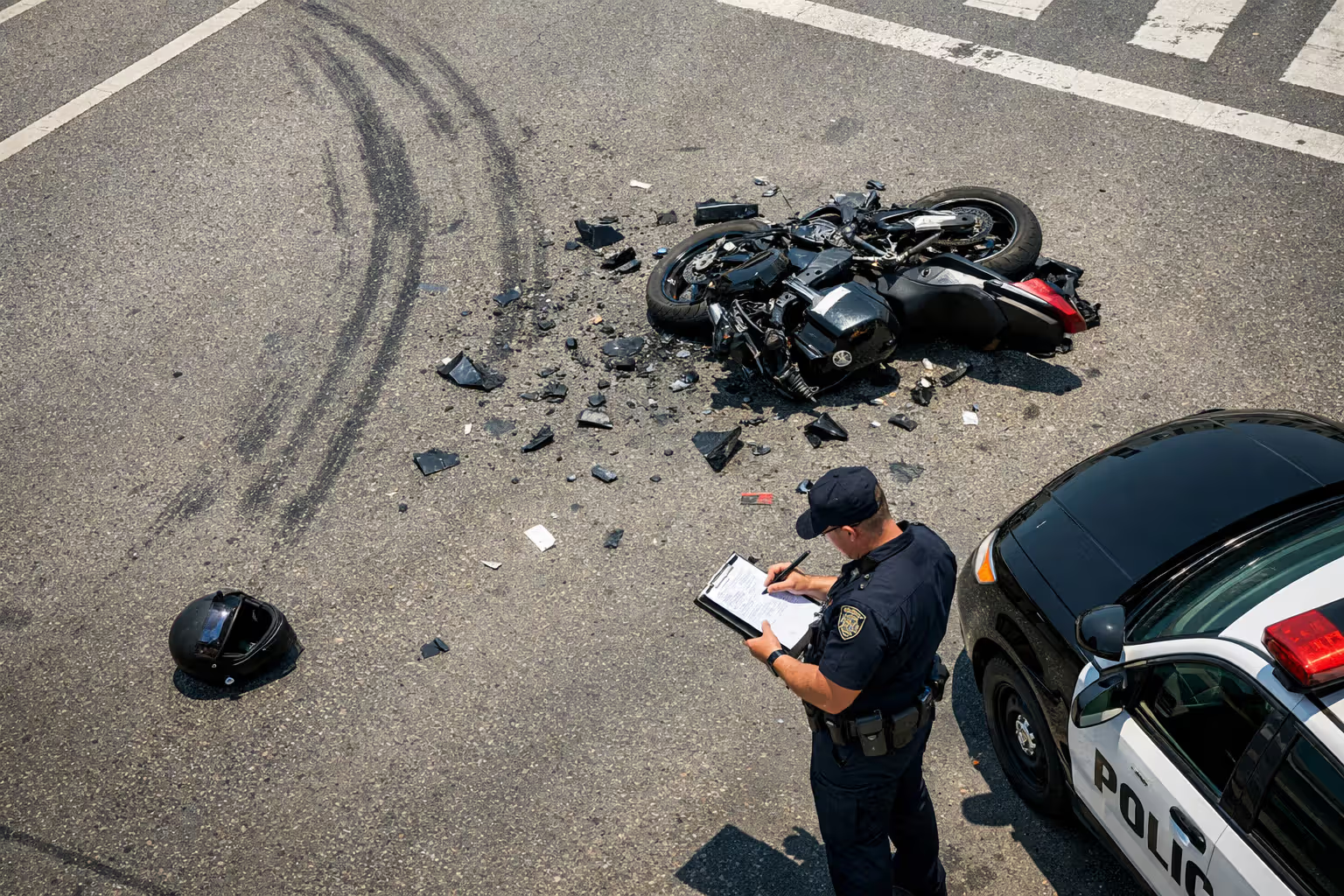
Photograph obsessively. Damage to your bike from every angle. Road surface. Skid marks. Debris scattered across the pavement. Traffic signals and signage. Your visible injuries. Shoot wide establishing shots, then zoom in on specific damage. Take fifty photos, not five.
Lock down witness information. Names, phone numbers, email addresses from everyone who saw what happened. Witness testimony becomes essential when the other driver disputes fault or when you're dealing with a phantom vehicle claim.
Document the other driver's details—if they stuck around. License plate number, driver's license, insurance card (even if it turns out to be invalid), vehicle description. This information helps your insurer investigate, even if their coverage proves worthless.
Seek medical attention the same day. Go to the ER or urgent care within hours. Any delay in treatment lets insurers argue your injuries weren't serious or didn't result from the crash.
Author: Caleb Thornton;
Source: spy-delhi.com
Notifying Your Insurance Company Within Required Timeframes
Most policies give you a narrow window to report accidents—sometimes just 24 hours for hit-and-runs, occasionally 72 hours for other UM claims. Dig out your policy declarations page and find the exact deadline.
When calling your insurer:
- Stick to facts about what happened without guessing who was at fault
- State clearly you'll need to file a UM or UIM claim
- Ask specifically about your coverage limits and any deductibles
- Request they mail or email your complete policy if you don't have it
Don't agree to give a recorded statement immediately. Tell them you'll fully cooperate but want to review your policy first and possibly speak with an attorney. You have every right to do this, and refusing doesn't violate your duty to cooperate.
Submitting Your Claim and Required Documentation
Your insurer assigns an adjuster and sends claim forms. Expect them to request:
Completed claim paperwork: Forms asking for accident specifics, injury descriptions, and medical providers you've visited.
Police report: Usually mandatory, especially for hit-and-run situations.
Medical documentation: Either authorization forms letting your insurer request records directly from providers, or copies you obtain and submit yourself.
Lost income verification: Recent pay stubs, a letter from your employer, or tax returns proving income you couldn't earn while recovering.
Photos and damage estimates: Even though UM/UIM covers bodily injury rather than property damage, bike damage documentation helps establish how severe the impact was.
Insurance verification: For UIM claims specifically, you need the at-fault driver's policy declarations showing their liability caps, plus proof you've either settled with or maxed out that policy.
Deadlines vary significantly, but most states give you one to three years from the accident date to file. That's the statute of limitations. But internal policy deadlines for notifying your carrier? Those run in days or weeks, not years.
How Underinsured Motorist Claims Differ for Motorcycle Accidents
The underinsured motorist motorcycle accident guide requires understanding calculations that don't apply to standard UM claims. The motorcycle UIM claim guide starts with grasping "offset" provisions.
Offset calculations: Most UIM policies use offsets. Say you carry $100,000 in UIM coverage and the at-fault driver's insurer pays their $25,000 limit. Your UIM coverage provides up to $75,000 additional compensation (the gap between the two numbers). Some states use a "cap" method—you can recover up to your UIM limit minus what the other policy paid, but your total can't exceed your UIM limit.
Trigger requirements: UIM coverage sits idle until you've either settled with the at-fault driver's carrier or obtained a court judgment against them. You can't file a UIM claim while still negotiating with the other insurance company. This creates a strategic puzzle: settle too fast with the at-fault insurer for their limits, and you might undervalue your entire claim, leaving your UIM coverage money on the table.
Stacking options: States permitting stacking let you combine UIM limits from multiple vehicles on your policy. Insure a motorcycle and a sedan, each with $50,000 UIM protection? Stacking delivers $100,000 total UIM coverage. Not every state allows this, and it typically increases premiums, but for motorcyclists facing catastrophic injury risks, that additional protection layer matters enormously.
Consent-to-settle clauses: Many UIM policies contain language requiring you to obtain your own insurer's permission before settling with the at-fault driver's carrier. Ignore this clause and you can forfeit your UIM coverage completely. Always notify your carrier before accepting any settlement from another party.
Common Mistakes That Delay or Deny Motorcycle UM/UIM Claims
Your own insurance company won't eagerly write you a check. You're filing against your carrier, and they'll scrutinize everything just as aggressively as if you were some stranger demanding money. Watch out for these traps:
Giving recorded statements unprepared: Adjusters ask seemingly innocent questions designed to undermine your claim. "You managed to walk away from the scene?" sounds harmless but gets twisted to argue you couldn't have been hurt that badly. Respectfully decline recorded statements until you've spoken with an attorney.
Accepting quick settlement offers: Some insurers dangle fast money—maybe $10,000 or $15,000—within the first week, before you understand how badly you're hurt. Sign that release and you can't come back later when you discover you need additional surgery.
Missing notification deadlines: Reporting your accident three weeks after it happened when your policy demands 72-hour notice hands the insurer ironclad grounds to deny your entire claim based on late notice.
Spotty medical documentation: Skipping follow-up appointments or going weeks between doctor visits creates treatment gaps. Insurers pounce on these, claiming you must not be seriously injured if you didn't consistently seek medical care.
Settling independently with the at-fault driver: For UIM claims, settling with the other driver without your insurer's knowledge or approval can void your UIM coverage. The consent-to-settle provision exists specifically to prevent this.
Exaggerating injuries: Overstating how much you're hurting destroys your credibility. When medical records contradict your claims, adjusters reject everything—even your legitimate injuries.
Destroying evidence: Getting your motorcycle repaired before your insurer inspects it or throwing away damaged riding gear eliminates proof of how hard you were hit.

Author: Caleb Thornton;
Source: spy-delhi.com
Calculating Your Compensation in a Motorcycle Uninsured Motorist Case
UM and UIM claims compensate you for identical damages you'd recover from the at-fault driver directly. Your policy limits cap what you can collect, but within those limits, you deserve full compensation.
Medical Expenses and Future Treatment Costs
This category includes every dollar you've paid or will pay for accident-related medical treatment:
- Emergency room charges and hospitalization
- Surgical procedures and anesthesia
- Appointments with physicians and specialists
- Physical therapy sessions and rehabilitation programs
- Prescription medication costs
- Medical equipment purchases (crutches, wheelchairs, prosthetics)
- Home health care or nursing services
- Future procedures or ongoing treatment needs
For future medical expenses, you need expert opinions from your treating doctors explaining what additional care you'll require and its anticipated cost. Insurers won't simply accept your assertion that you need another operation—you need documented medical evidence.
Lost Wages and Diminished Earning Capacity
When your injuries prevented you from working, you can recover:
Past lost income: Document this with pay stubs, tax returns, and letters from your employer. Self-employed riders need profit-and-loss statements plus tax returns showing pre-crash income.
Future lost income: If you can't return to your previous job or can only manage part-time hours, you can claim the gap between what you would have earned and what you can earn now. This needs vocational expert testimony and economic calculations projecting losses across your remaining work life.
Lost earning capacity: This differs from lost wages—it compensates you for the permanent reduction in your ability to earn money in the future, even if you're currently employed. A welder who loses partial use of their dominant hand can still work, but their career options and earning potential have been permanently damaged.
Pain and Suffering Multipliers
| Damage Type | What's Included | Calculation Method | Typical Range |
| Economic damages | Hospital bills, lost income, future medical needs, reduced earning capacity | Documented actual expenses plus expert-projected future costs | $50,000–$500,000+ depending on severity |
| Non-economic damages | Physical pain, emotional suffering, mental distress, reduced quality of life, permanent disfigurement | Multiplier method (1.5x–5x economic damages) or daily rate method | $25,000–$1,000,000+ for life-altering injuries |
| Special considerations for motorcyclists | Road rash treatment, skin graft surgery, permanent scarring, post-traumatic stress, inability to ride again | Medical documentation, psychological evaluations, personal testimony about life changes | Typically adds 10–30% to baseline non-economic damages |
Non-economic damages—pain, suffering, emotional trauma, loss of life enjoyment—don't come with receipts. Insurers and attorneys frequently use a multiplier approach: take your economic damages (medical bills plus lost wages) and multiply by a factor between 1.5 and 5, depending on how severe your injuries were.
Minor injuries (soft tissue damage, rapid recovery) might justify a 1.5x multiplier. Catastrophic injuries (amputations, permanent disability, brain trauma) might warrant 4x or 5x. Medical bills totaling $100,000 with a 3x multiplier yields $300,000 in pain and suffering damages, bringing your total claim to $400,000.
Your UM/UIM policy limits place a hard cap on recovery. If you carry $100,000 in coverage but your damages total $400,000, you'll only collect $100,000 from your UM/UIM claim. You can still sue the at-fault driver personally for the remaining $300,000, but if they're uninsured, actually collecting on that judgment is nearly impossible.

Author: Caleb Thornton;
Source: spy-delhi.com
Frequently Asked Questions About Motorcycle UM/UIM Claims
Protecting Yourself When Others Won't
The most frustrating part about getting hit by an uninsured or underinsured driver is the sheer unfairness. You did everything right—maintained insurance, wore protective gear, rode defensively—and still wound up broken because someone else couldn't be bothered to maintain coverage. Your UM/UIM protection doesn't erase that injustice, but it does prevent financial catastrophe from compounding physical injury.
Pull out your current motorcycle insurance policy today. Look at your UM and UIM limits. If they're lower than your liability coverage, or if you declined them years ago to save fifty bucks on premiums, call your agent tomorrow and increase them. The cost difference is minimal—frequently $100 to $200 per year—while the protection difference can be hundreds of thousands of dollars.
When you're healing from a motorcycle crash, battling your own insurance company is the last thing you need energy for. Understanding exactly what documentation to collect, which deadlines actually matter, and which mistakes will sink your claim gives you the best shot at fair compensation. And if your insurer drags their feet or offers an insulting settlement, don't hesitate to consult an attorney who regularly handles motorcycle UM/UIM claims. You paid for that policy. Make absolutely certain you get what you're owed.
Related Stories
Read more
Read more




The content on this website is provided for general informational and educational purposes only. It is intended to offer insights and guidance on motorcycle accident insurance claims, settlement processes, liability issues, coverage limits, medical compensation, and related insurance matters, and should not be considered legal or financial advice.
All information, articles, and materials presented on this website are for general informational purposes only. Insurance policies, liability standards, settlement practices, and state regulations may vary by jurisdiction and insurer. The outcome of a motorcycle accident claim depends on the specific facts of the accident, available evidence, policy language, and applicable law.
This website is not responsible for any errors or omissions in the content, or for actions taken based on the information provided. Users are strongly encouraged to consult with a qualified attorney or licensed insurance professional regarding their specific motorcycle accident claim before making decisions about settlements, negotiations, or coverage disputes.